San Francisco-based Worki Raises $2.75M Pre-Seed to Build AI Workforce Infrastructure
Worki, a San Francisco-based healthcare workforce infrastructure company, has raised $2.75 million in pre-seed funding led by Redesign Health and Healthliant Ventures. The company aims to address a critical gap in healthcare AI adoption by building a unifying infrastructure layer that connects fragmented workforce systems and enables practical AI deployment across real workflows. Its core innovation lies in a task-role architecture that maps work at the task level, providing organizations with visibility into operations and a structured roadmap for AI integration.
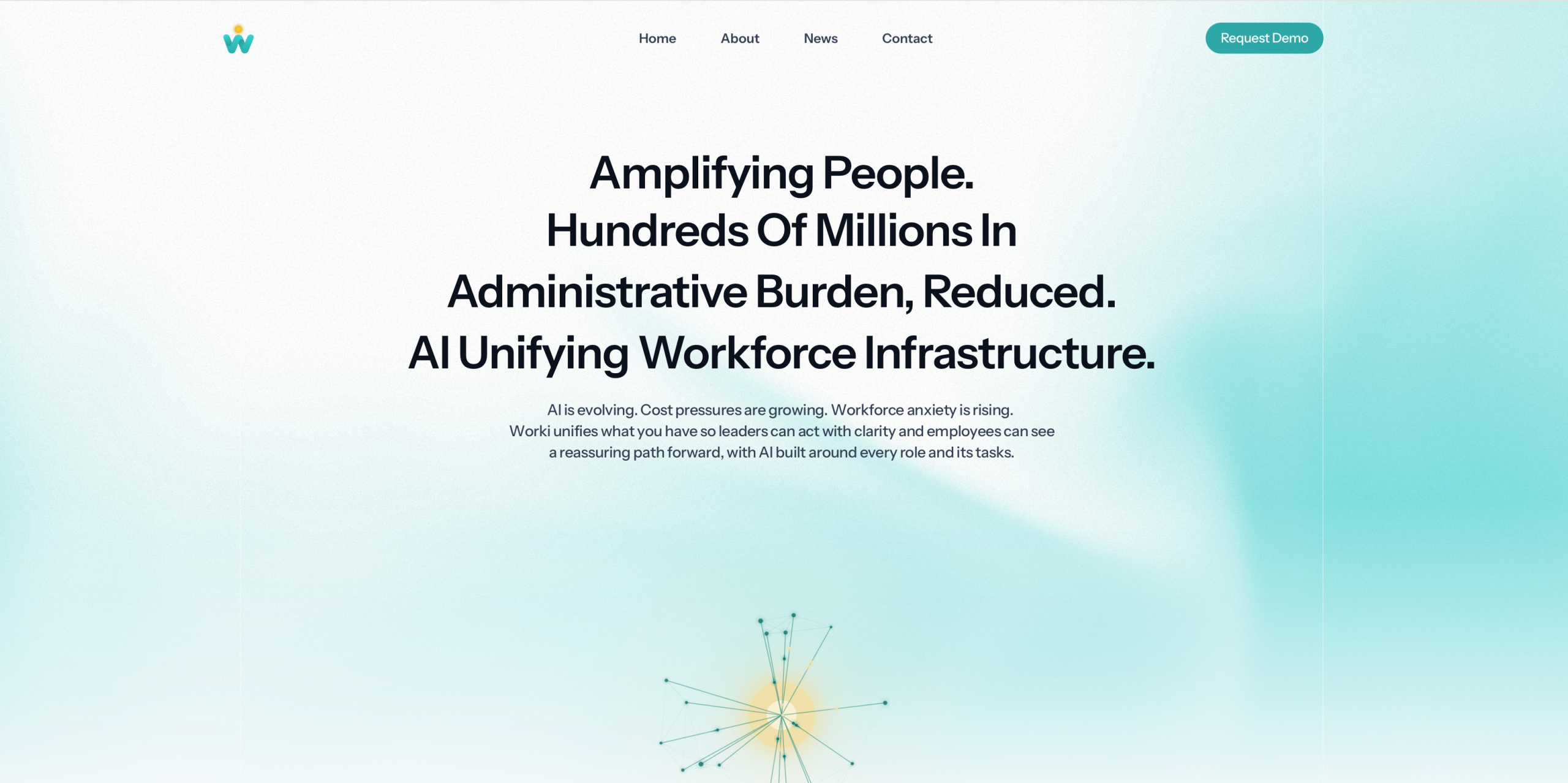
Backed by Redesign Health and Healthliant Ventures, Worki is building the connective layer to help health systems implement AI, reduce administrative burden, and navigate growing workforce anxiety.
SAN FRANCISCO,
April 16, 2026 --
Worki, a healthcare workforce infrastructure company, today announced it has raised $2.75 million in pre-seed funding led by Redesign Health, a healthcare venture builder, and Healthliant Ventures, Tanner Health's venture arm, to help health systems reduce administrative overhead and navigate the shift to AI-driven operations.
Health systems are moving past AI experiments and into real implementation, but many are still figuring out where they're headed, all while trying to modernize how they operate and reassure their teams about what this means for their jobs. Worki addresses this by providing an infrastructure layer that connects workforce systems and enables AI to be deployed across real roles and workflows with humans remaining at the center of all tasks.
The investment from Redesign Health and Healthliant reflects growing demand for solutions that bring structure to a fragmented landscape, giving leaders visibility into how work is performed and a way to introduce AI without disrupting their workforce. Early deployments have already shown measurable impact, with health system partners reducing administrative burden and projecting meaningful cost savings as adoption scales.
Central to Worki's approach is a task-role architecture that maps how work is performed across healthcare administrative and operational functions. This structured mapping creates an actionable contextual layer, a roadmap that identifies precisely where AI agents can augment, automate, or streamline specific tasks within existing roles. Rather than deploying AI broadly and hoping for adoption, the contextual layer provides each agent with the granular intelligence it needs to operate within the boundaries of real workflows. Decisions about where to introduce automation are grounded in how organizations actually function, spanning credentialing, onboarding, redeployment, skills development, and workforce planning, not in abstract job titles or org charts. This task-level specificity is what allows Worki's agent infrastructure to scale across departments and systems while maintaining the operational clarity that health system leaders require before committing to AI-driven change.
Worki's founding team brings deep experience across healthcare operations, commercial strategy, and artificial intelligence. CEO Craig Allan Ahrens brings workforce operations and healthcare startup scaling expertise, and CCO Michael Biggs brings extensive experience in healthcare commercial strategy and go-to-market execution, while CTO Harvey Hongwei Li, PhD, previously led AI and machine learning initiatives at Uber and Airbnb. The complementary strengths of the founding team were a key factor in investor interest.
"Worki is building the infrastructure that healthcare organizations need to operationalize AI across their workforce, connecting fragmented systems and giving leaders clarity on where AI can augment and automate work," said Neil Patel, Head of Ventures at Redesign Health. "The founding team's combination of advanced AI expertise and hands-on healthcare operating experience is exactly why we backed them."
"As the venture arm for Tanner Health, we're constantly evaluating new technologies based on how they perform inside real health system environments, not just how they're positioned," said Steve West, Managing Director at Healthliant Ventures, with backing from Tanner Health. "What stood out about Worki is that it's built to operate within the complexity of workforce operations, not around it. That's critical for any organization trying to move from AI experimentation to something that actually works in practice."
"Health systems are being asked to adopt AI while reducing costs, and their workforce is feeling that pressure," said Ahrens. "Leaders don't have a clear roadmap for how to do that without making the wrong cuts or creating more uncertainty. What we're building is the task level AI infrastructure that brings clarity to that process, connecting systems, mapping how work is performed, and giving organizations a way to introduce AI that supports and reassures their teams while driving real operational change."
Worki is currently working with health systems including Tanner Health, BJC Healthcare, and other large organizations nationwide, with additional partnerships and expansions underway.
With this funding, Worki plans to expand its platform across additional health systems and continue developing its infrastructure to support more complex workforce environments. While the company is initially focused on healthcare, it intends to extend its model to other complex, highly regulated industries facing similar operational challenges.
For more information, visit
www.worki.ai.
About Worki
Worki is building the connecting AI infrastructure layer for dramatically lowering costs and improving productivity in healthcare workforce and HR operations. The company's AI-native infrastructure sits between the systems health systems already use, including Workday, UKG, Oracle, ServiceNow, AI point solutions, ATS, LMS, and others, unifying workforce and HR data into the connective tissue that provides a context layer powering AI-driven decisions and the development of AI agents around functional roles. Four capabilities organize the platform: Pathways (mapping how AI reshapes healthcare administrative tasks), Unify (creating a single modular data identity across siloed systems), Amplifiers (translating intelligence into operational action via agents that amplify traditional HR roles), and Infrasharing (scaling workforce intelligence and AI agent infrastructure across organizations).








 Back
Back

 X.com
X.com