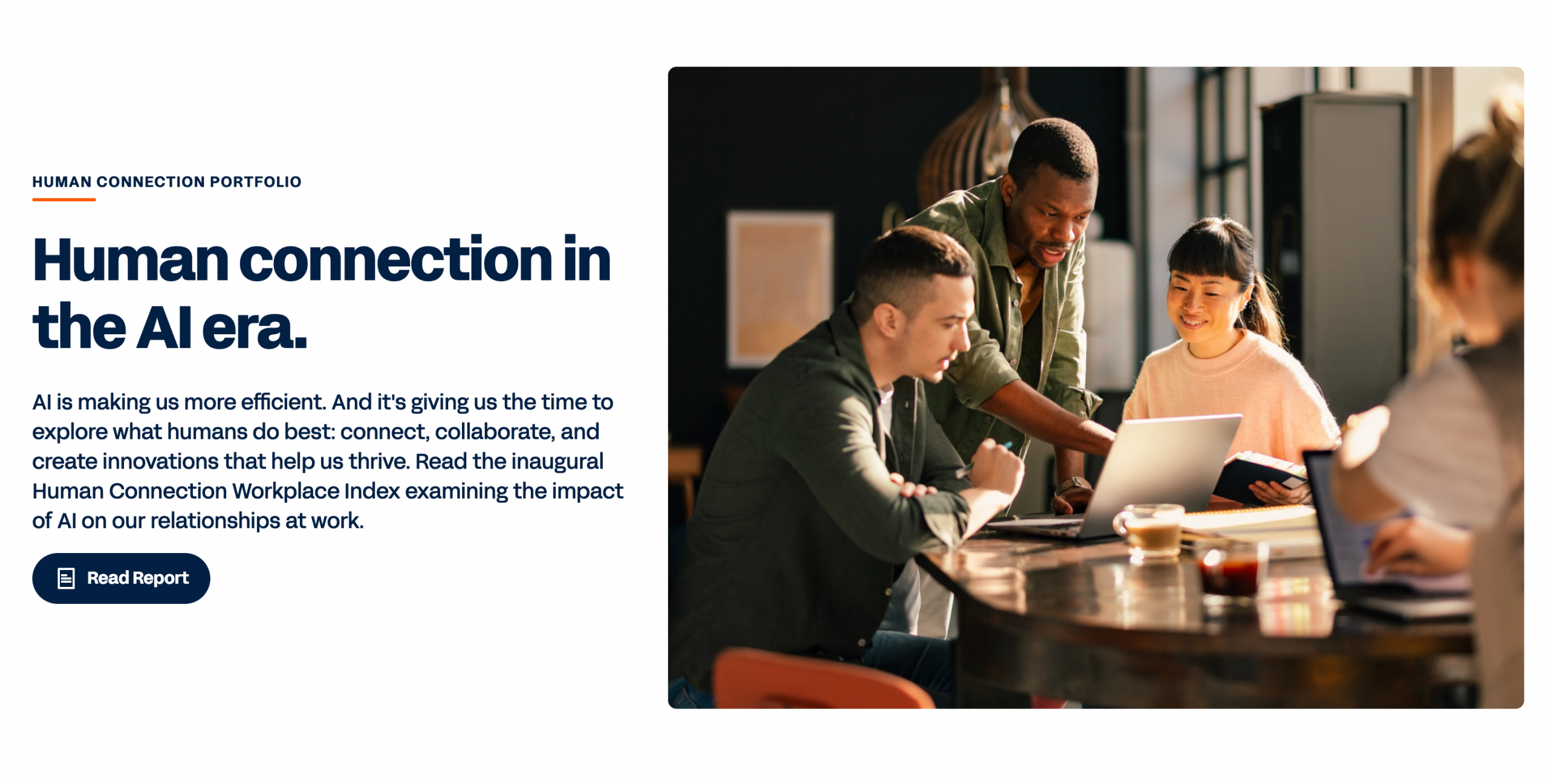
Workday Global Research Finds AI Reduces Burnout but May Deepen the Workplace Connection Deficit
Workday’s new Human Connection Workplace Index surveyed 2,150 AI-using employees across 7 countries. While 62% say AI has reduced stress or burnout risk and 86% feel more productive, 14% have taken time off due to loneliness or social isolation.
 PLEASANTON, Calif.
,
May 27, 2026 --
Workday, Inc. (NASDAQ: WDAY), the enterprise AI platform for HR, finance, and IT, today released new global research showing that while AI is reducing burnout and boosting confidence at work, it may also be contributing to a growing "connection deficit" in the workplace. Younger employees are most at risk, with 20% of surveyed Gen Z workers reporting they took time off work this year due to feelings of loneliness or isolation.
The
Human Connection Workplace Index surveyed 2,150 workers who actively use AI at large enterprises across industries and geographies, and measured how AI is reshaping trust, collaboration, and social connection at work. According to the report's findings, the deployment of AI has introduced positive benefits, including:
AI is reducing burnout and increasing productivity: 62% of employees say their stress or burnout risk has decreased since they started using AI, and 86% feel more productive because of AI. Many also say AI tools have helped them focus on higher‑value, strategic work.
Employee confidence is rising: Nearly two-thirds (64%) say AI has increased their confidence in their ability to succeed in future roles.
However, alongside those gains, the Index reveals a potential early shift in how colleagues relate to one another:
Everyday connection may be slowly eroding: A third (33%) rarely or never have conversations with colleagues that go beyond transactional work‑related tasks in a given week, and fewer than half (46%) find it easy or somewhat easy to make friends at work. 14% of all employees surveyed have taken time off due to loneliness or social isolation in the past year.
AI feels more "socially frictionless" than colleagues: Since adopting AI, 16% of respondents say now they have less patience for small talk. In the last 12 months, 76% have used an AI tool to get advice, 52% to brainstorm, and 37% even for companionship, with many citing AI's judgment‑free and always‑available support as reasons they turn to the technology instead of colleagues.
The generational gap in connection at work is stark: Gen Z is 12 times more likely than Gen X to report feeling completely disconnected from colleagues, and twice as likely as millennials and eight times as likely as Gen X to feel lonely at work. More than one‑fifth say AI tools have made their personal relationships with colleagues worse and report feeling more lonely since AI tools were introduced in the workplace.
The Index's findings come at a time when low employee engagement is
reported to have cost the world economy $10 trillion in lost productivity last year alone. Additionally, when asked what worries them most about AI, 43% of respondents
cite reduced human-to-human interaction as their top worry - ahead of job loss, underscoring the urgent need to address human connection as AI adoption accelerates.
"We are seeing that AI is having a very positive effect on productivity at work, and employees across all industries globally are clearly telling us they feel less burned out than before they started using AI tools," said Carrie Varoquiers, chief impact officer at Workday. "But our Index cautions that, as we route more questions, ideas, and even conflicts through AI, we risk losing the everyday human interactions that build trust, resilience, and a sense of connection. Through the Workday Foundation, we are investing in solutions that use AI's efficiency gains to strengthen our human connections."
This report advises that, to address this challenge, leaders must treat social connection as core infrastructure. That means intentionally designing how people collaborate, give feedback, and receive mentorship; tracking how AI is shaping trust, belonging, and cross‑team relationships; and putting guardrails in place so AI augments, rather than replaces, the difficult conversations that build resilience and innovation.
Workday Foundation Microgrant Initiative to Strengthen Human Connection
To further help address this emerging connection deficit, the Workday Foundation is committing $500,000 USD in small grants ranging from $2,500 to $10,000 for eligible nonprofits around the world that are building human connection in their communities. Funding priorities will include programs that create joyful activities that turn strangers into friends, foster intergenerational conversations, and use prosocial technology to accelerate social connections across neighborhoods and interests.
Learn more about eligibility for the Workday Foundation Microgrant Initiative and how to apply
here.
About the Human Connection Workplace Index
The Human Connection Workplace Index is a global survey conducted by the Workday Foundation and fielded by Hanover Research in March - April 2026. The study surveyed 2,150 full-time employees in seven countries at organizations with 3,500+ employees who actively use AI to measure how AI adoption is affecting human connection, collaboration, and trust at work.
About the Workday Foundation
The Workday Foundation is a private foundation funded by Workday, Inc. Its mission is to elevate human potential through the power of purposeful work and meaningful connection in the AI era. Through strategic grantmaking and partnerships, the Workday Foundation invests in solutions that continuously build skills for in-demand careers, deepen human connections, and empower individuals and communities to remain resilient in a rapidly changing world. For more information, visit
workday.com/foundation/.
About Workday
Workday operates at the heart of the enterprise—HR, finance, and IT—where the margin for error is effectively zero. By tightly coupling AI with the context, guardrails, and trusted processes that run the business, Workday goes beyond AI that assists with work to agents that are capable of driving measurable outcomes. More than 11,500 organizations worldwide, including more than 65% of the Fortune 500, trust Workday to deliver. For more information about Workday, visit
workday.com.
Forward-Looking Statements
This press release contains forward-looking statements including, among other things, statements regarding Workday's plans, beliefs, and expectations. These forward-looking statements are based only on currently available information and our current beliefs, expectations, and assumptions. Because forward-looking statements relate to the future, they are subject to inherent risks, uncertainties, assumptions, and changes in circumstances that are difficult to predict and many of which are outside of our control. If the risks materialize, assumptions prove incorrect, or we experience unexpected changes in circumstances, actual results could differ materially from the results implied by these forward-looking statements, and therefore you should not rely on any forward-looking statements. Risks include, but are not limited to, risks described in our filings with the Securities and Exchange Commission ("SEC"), including our most recent report on Form 10-Q or Form 10-K and other reports that we have filed and will file with the SEC from time to time, which could cause actual results to vary from expectations. Workday assumes no obligation to, and does not currently intend to, update any such forward-looking statements after the date of this release, except as required by law.
Any unreleased services, features, or functions referenced in this document, our website, or other press releases or public statements that are not currently available are subject to change at Workday's discretion and may not be delivered as planned or at all. Customers who purchase Workday services should make their purchase decisions based upon services, features, and functions that are currently available.
SOURCE Workday Inc.










 Back
Back

 X.com
X.com