Why a Framework — and Why Now
The challenge facing HR professionals today is not awareness. Most people working in HR have heard of AI, tried a tool or two, and can describe in broad strokes what it might do for their work. The challenge is something more specific: the gap between having used AI and having built a genuinely new way of working.
That gap is harder to see, harder to diagnose, and much harder to close — because there is no clear standard for what “capable” actually looks like. Without a shared language for AI capability, HR professionals are left comparing themselves to nothing. They do not know whether they are ahead, behind, or simply somewhere in the middle.
The HR AI Forward Maturity Framework exists to provide that standard. It is not a course curriculum. It is not a tool ranking. It is a capability model — a structured way of understanding where an HR professional currently stands in their relationship with AI, what is holding them at their current level, and what a genuine transition forward would actually require.
What the Framework Measures
The framework measures one thing above all: whether AI has actually entered a professional's way of working.
This sounds simple. In practice, it requires distinguishing between several very different states that often get collapsed into the same label of “uses AI.”
The framework does not measure whether someone knows what a large language model is. It does not test prompt-writing as an isolated skill. It does not ask about familiarity with specific platforms or tools. What it measures is the actual state of AI in a professional's daily working reality — the habits, structures, methods, and thinking patterns that either are or are not present.
The Four-Level Structure
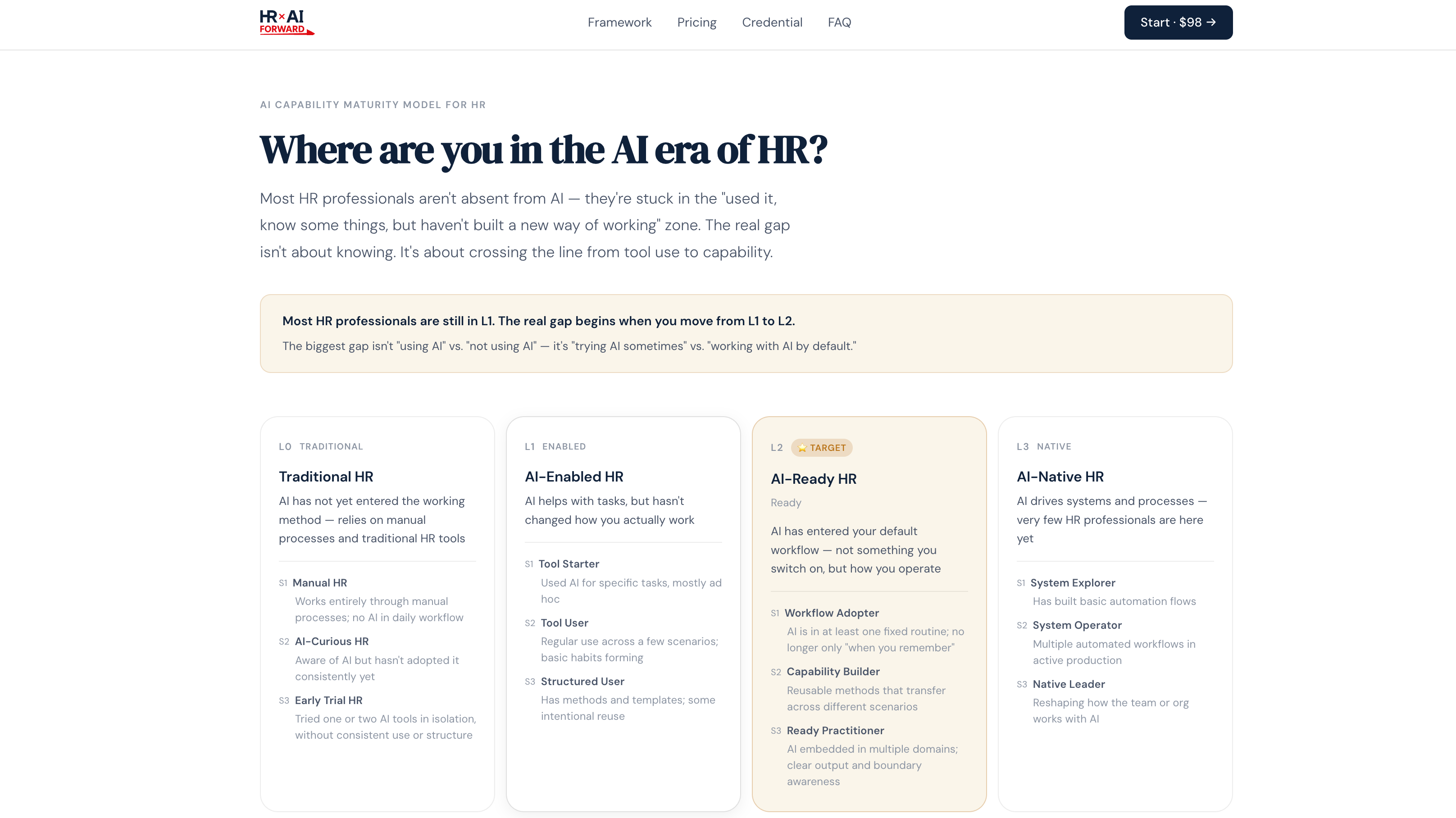
The HR AI Forward Maturity Framework organizes AI capability into four levels, each representing a meaningfully different relationship between the HR professional and AI. Each level contains three stages — twelve stages in total.
AI-Enabled HR
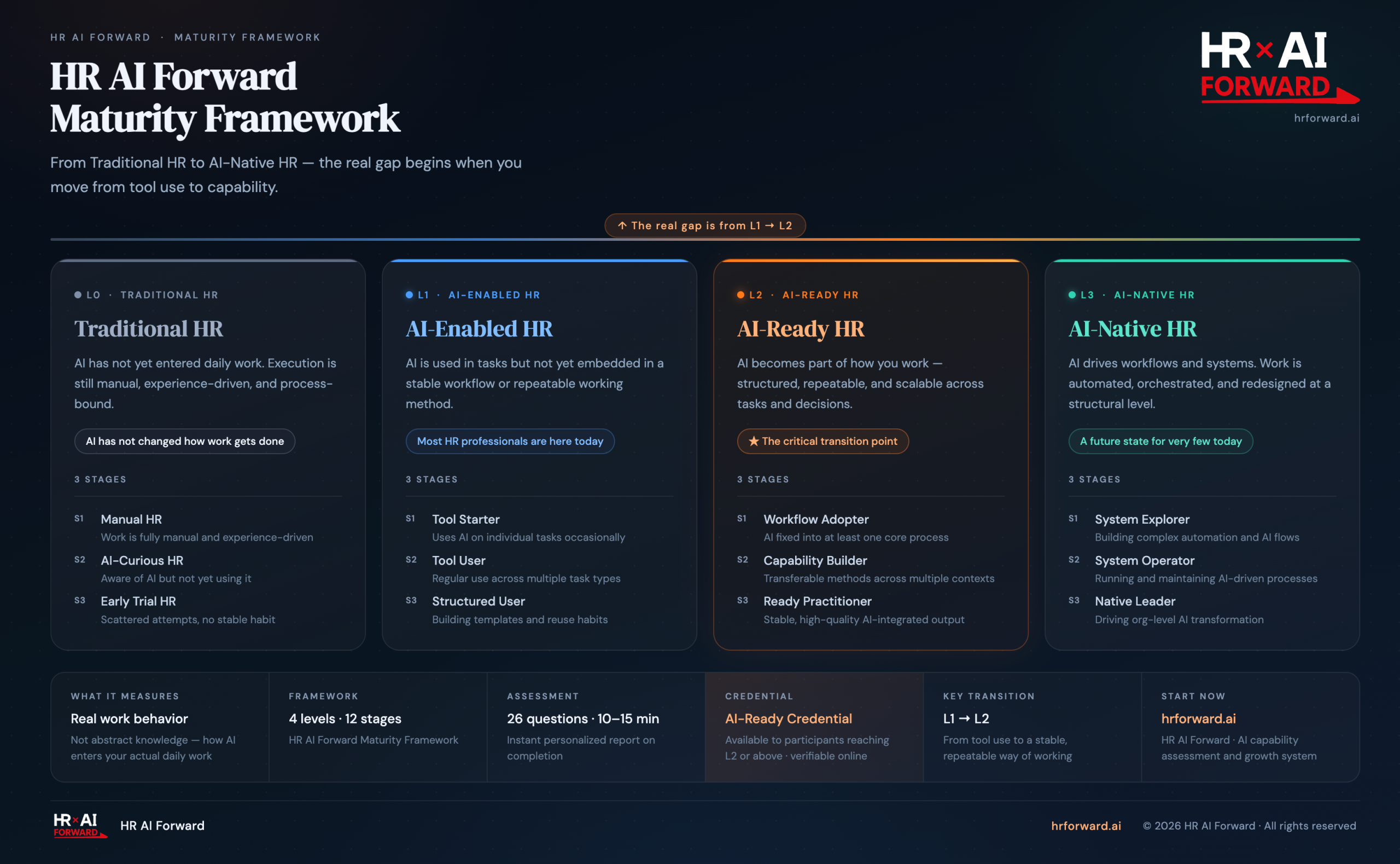
The Critical Transition: L1 to L2
Of all the movements within the framework, the transition from L1 to L2 is the one that matters most — and the one that is most commonly underestimated.
Moving from L0 to L1 is primarily a matter of starting. It requires exposure, experimentation, and the development of basic familiarity. That is a real change, but it is a relatively accessible one. The tools exist, the use cases are visible, and the initial benefits are immediate enough to sustain early motivation.
Moving from L1 to L2 is a fundamentally different kind of challenge. It does not happen through more tool use. It does not happen through more prompts or more platforms or more experimentation. It happens through a structural shift in how the professional thinks about and organizes their work — a shift that requires deliberate effort, reflection, and a willingness to rebuild habits rather than simply add to them.
Why this transition stalls
The reason this transition is so commonly stalled is that L1 feels good. Regular AI use feels like progress. The efficiency gains are real. The sense of being a capable AI user is not wrong exactly — but it is incomplete. What L1 does not provide is the structural foundation that allows AI capability to compound, transfer, and sustain over time.
That foundation is what L2 represents. And building it is what the HR AI Forward Maturity Framework is designed to support.
The distinction between L1 and L2 is not primarily about how much someone uses AI. It is about whether AI has become structurally embedded in how they work, or whether it remains an optional extra layer they apply when convenient.
Why This Framework Uses Stages, Not Just Levels
The four-level structure provides the primary architecture of the model. But within each level, the three-stage breakdown adds a precision that matters significantly in practice.
A professional at L2-S1 and a professional at L2-S3 are both AI-Ready HR. But they are in very different places. The first has just begun to structurally integrate AI into their work — the change is real but fragile, and there is a long way to go within the level. The second has achieved a mature, stable, multi-context AI-integrated working style and is approaching the threshold where L3 becomes the relevant horizon.
If the framework only used levels, these two professionals would receive the same description, the same diagnosis, and the same growth guidance — which would be accurate for neither of them. The stage structure allows the framework to be genuinely useful at the individual level, not just as a broad categorization tool.
What This Framework Does Not Measure
Clarity about what a framework measures requires equal clarity about what it does not.
Abstract AI knowledge
Knowing the terminology of machine learning, being familiar with the history of AI development, or being able to explain how a large language model works — none of these are what the framework assesses. Knowledge of that kind may accompany capability, but it does not constitute it.
Prompt-writing skill in isolation
Writing effective prompts is part of what capable AI use looks like, but a single impressive prompt does not indicate structural capability. The framework is concerned with consistency, transferability, and integration — not peak performance on a specific task.
Tool familiarity
The specific platforms a professional uses, the number of tools they have tried, or how recently they have adopted new products are not what the model captures. Tools change. The capability to work effectively with AI across whatever tools are available is what endures.
A Standard for a Transitional Moment
The HR AI Forward Maturity Framework was built for a specific moment: the period in which AI has become genuinely relevant to professional HR work, but the standards for what AI capability actually means have not yet been established.
In that moment, the absence of a shared framework creates real problems. Professionals cannot accurately assess their own position. Organizations cannot identify genuine capability versus surface-level familiarity. The people who are doing the real work of building AI-ready capability have no way to make that capability visible.
The framework addresses each of these problems. It gives professionals a clear, honest picture of where they stand. It gives organizations a language for capability that goes beyond tool adoption. And it gives those who have made the genuine transition to AI-Ready or beyond a way to demonstrate what that actually means.
From Framework to Assessment
Understanding where you are within a maturity framework requires more than self-assessment. Most professionals significantly underestimate or overestimate their own position — because the signals that distinguish one level from another are not always obvious from the inside.
That is what the HR AI Forward assessment is designed to address. Built directly on this framework, the assessment evaluates real working habits, usage patterns, and capability signals — not abstract knowledge, not tool familiarity, but the actual state of AI in a professional's daily work.
The assessment comprises 26 questions, takes 10–15 minutes to complete, and produces an instant personalized report that places the participant within the framework with specificity — not just at the level, but at the stage. For participants who reach L2 or above, the assessment may also result in the AI-Ready Credential — a verifiable capability credential designed to signal demonstrated capability rather than course completion.

Subscribe to our newsletter and never miss our latest digital HR news!
By signing up to receive DHRmap newsletter, you agree to our Terms of Use and Privacy Policy. You can unsubscribe anytime.








We have placed cookies on your device to help make this website better. You can adjust your cookie settings, otherwise we'll assume you're okay to continue.

 Back
Back

 X.com
X.com