Microsoft Cuts 4,800 Roles as AI Reshapes Work, Commercial Delivery and Xbox Strategy
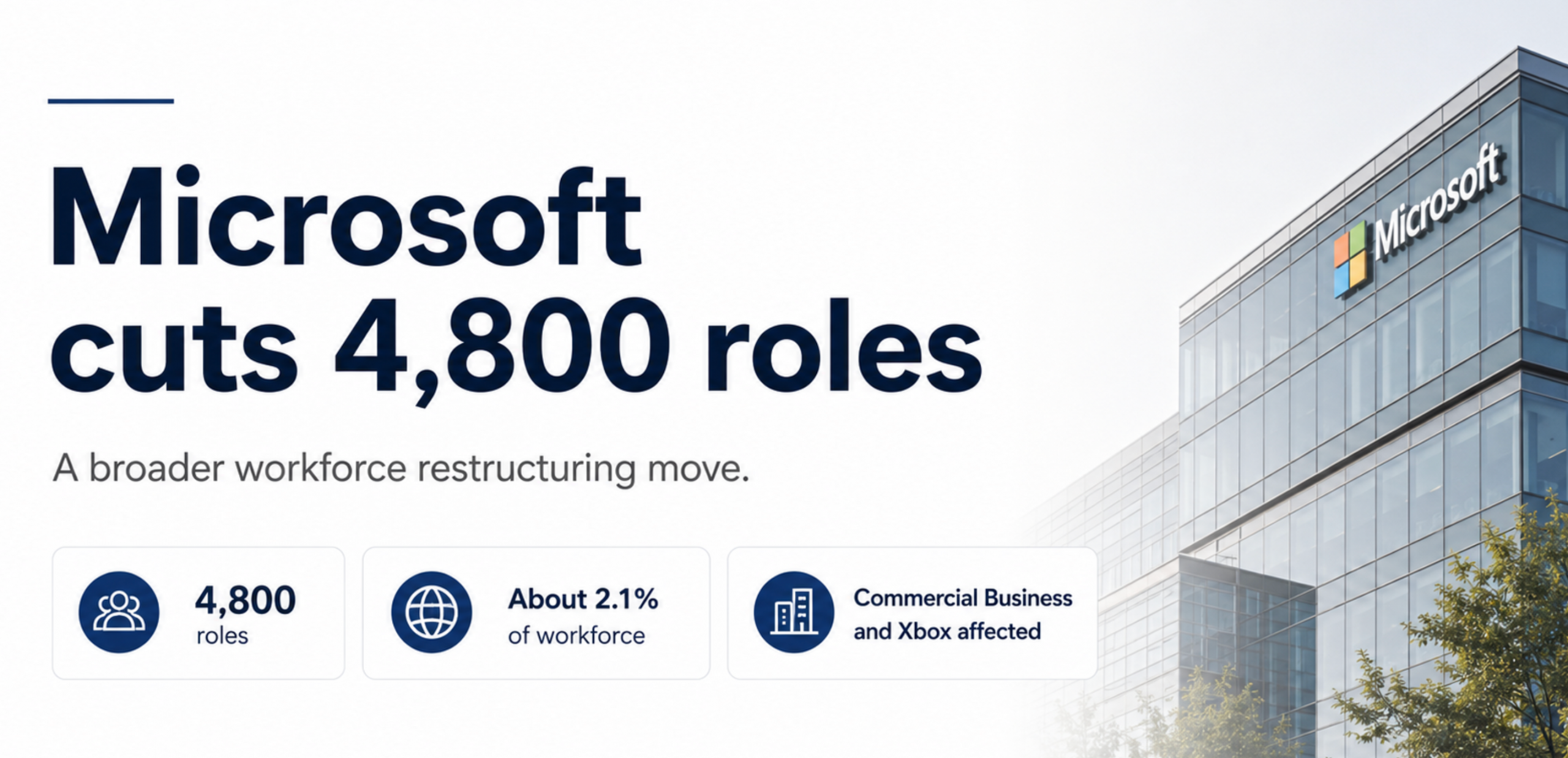
Microsoft is eliminating around 4,800 roles, representing about 2.1% of its global workforce, as the company accelerates a broader transformation of its business, operating model and workforce priorities. The changes primarily affect Microsoft’s Commercial Business and XBOX organizations, according to an internal employee communication shared by Amy Coleman, Microsoft’s EVP and Chief People Officer.
The announcement marks one of Microsoft’s most visible workforce moves in 2026 and comes as the company continues to redirect people, investment and organizational energy toward higher-priority growth areas. Coleman said the company is making the changes to stay positioned for customers in a fast-changing industry, where technology development, deployment models and customer needs are evolving rapidly.
“Our business is changing because the world around it is changing,” Coleman told employees in the memo. She said Microsoft must adjust resources, roles and operating structures to focus on areas where the company can deliver the greatest impact for customers.
A central point in the communication is Microsoft’s attempt to distinguish between AI-driven work transformation and direct AI replacement. Coleman stated that the roles eliminated in this round are “not being replaced by AI.” At the same time, she acknowledged that AI is changing how work gets done across the company. Some daily tasks can now be automated, and employees will need to continue learning, building new skills and adapting as work evolves.
For HR and workforce leaders, this distinction is important. Microsoft’s latest move is not framed as a simple case of AI replacing employees. Instead, it reflects a more complex workforce transformation pattern: AI changes the work, the work changes the operating model, and the operating model changes the shape of the organization.
Microsoft said it is also using alternatives to job eliminations where possible. Over the past year, the company has redeployed more than 4,000 employees into new roles, including another 500 this month. More than 30% of eligible employees also chose to participate in a recent voluntary retirement program. Coleman said Microsoft will continue exploring similar approaches in the future to reduce the need for job eliminations where possible.
The company is also transitioning four gaming studios to operate under new management, with the goal of preserving intellectual property and ongoing projects. External reports indicate the Xbox organization is undergoing a major restructuring, with significant job cuts across the gaming business and changes to studio ownership and management structures. Reuters reported that the restructuring includes 3,200 job cuts within gaming, including 1,600 layoffs on the announcement day.
The XBOX changes reflect pressure on Microsoft’s gaming business to become more focused, disciplined and financially sustainable. The Verge reported that the latest cuts primarily affect commercial sales and Xbox, with about 1,600 Xbox employees impacted immediately and a larger restructuring underway across the gaming unit. Business Insider also reported that Xbox plans to reduce approximately 20% of its workforce during fiscal year 2027 as part of a broader reset of the division.
In the Commercial Business, Microsoft said the changes build on last week’s Frontier Company announcement. The company is reshaping how it works with customers by embedding engineering experts more closely alongside them to accelerate technology deployments. This suggests a shift from traditional enterprise sales and consulting models toward a more deployment-led commercial approach, where technical experts are placed closer to customer implementation and value realization.
That shift is highly relevant for enterprise HR leaders. As AI becomes more central to customer strategy, companies are likely to redesign go-to-market teams, sales engineering roles, consulting structures and customer success models. The Microsoft case shows that AI transformation is not only a product or infrastructure issue. It directly affects workforce planning, role architecture, internal mobility, skills strategy and organizational design.
Microsoft’s message to employees also signals that more change is ahead. Coleman said the company is still early in the journey and that other parts of the business will need to make similar changes. Each round of change, she said, should be guided by two commitments: making hard decisions required to deliver differentiated customer value, and supporting people affected by those decisions.
The broader market context adds another layer to the story. Reuters reported that Microsoft’s restructuring comes amid rising pressure to show returns on major AI investments, while data center and infrastructure costs continue to grow across the technology sector. The company is not alone. Large technology firms are increasingly cutting, redeploying or restructuring workforces while simultaneously increasing AI-related capital expenditure and product investment.
For DHRmap, the Microsoft case highlights a key trend in the future of work: AI transformation is becoming workforce transformation. The real impact of AI may not appear only as direct job replacement. It may be seen more often through role redesign, management layer reduction, redeployment, voluntary retirement programs, new skills requirements and the reallocation of talent toward strategic growth areas.
For HR leaders, the implications are clear. Workforce planning can no longer be separated from AI strategy. Reskilling cannot be treated as a general learning initiative disconnected from business priorities. Internal mobility will become a strategic capability, not an HR process. And organizations will need clearer frameworks to explain when AI changes work, when roles should be redesigned, and when workforce reductions become part of broader business transformation.
Microsoft’s latest announcement is therefore more than a layoff story. It is a signal of how large enterprises are beginning to reorganize around AI-era operating models: fewer legacy structures, more direct customer deployment capabilities, sharper business focus and greater pressure on employees to continuously adapt.










 Back
Back

 X.com
X.com