Workday Rising 2026: What HR Buyers Need to Know
Autopilot agents, Sana as the new Workday Home and inside Claude, Copilot, Teams and Slack, a headless agent platform, Decision and Work Intelligence, Candidate Profile and an Anthropic partnership — what is available now and what is roadmap.
Key facts
- Workday Rising 2026 runs October 12–15 in Las Vegas; Workday's main announcements were released on October 13.
- Talent Acquisition Agent autopilot capabilities are available to early adopters now, with general availability planned for early 2027; Payroll, Accounting and Deployment Agent autopilots reach early adopters in early 2027.
- Sana is the new Workday Home, available now; Sana Concierge (HR and IT service agent) is expected to be generally available in Q1 2027.
- Sana is coming to Claude, Gemini Enterprise, Microsoft Copilot, Teams and Slack; self-service is generally available in four of those tools today.
- The Trusted Agent Platform is now headless: Agent-Ready Tools (MCP), Custom Agents, Developer Agent, Workday Data Cloud and Agent Harness are generally available.
- Decision Intelligence is now available to Workday HCM and Financial Management customers.
- Work Intelligence, which breaks jobs into tasks and skills, is in early access for Workday HCM customers.
- Workday Candidate Profile is expected to be generally available to Workday Recruiting customers in early 2027.
- Workday and Anthropic announced a partnership connecting Sana and Claude through MCP; the Sana in Claude plugin is in early access, with general availability expected in late 2026.
Workday used the first full day of Workday Rising 2026 in Las Vegas (October 12–15) to release a wave of product news. The eight main announcements of October 13 nearly all make the same argument: AI agents in HR and finance are only useful if they act inside each company's own permissions, policies and approvals — what Workday now calls agents that are "lawful by design." Below is what was announced, what is available now and what is still roadmap.
1. Autopilot agents for recruiting, payroll and accounting
Workday's agents now run continuously in the background instead of waiting to be asked. The Talent Acquisition Agent watches open requisitions, flags roles at risk of missing their fill date, surfaces qualified applicants and gaps, and can draft sourcing outreach, coordinate interview scheduling and draft interviewer feedback. Outreach to candidates still needs recruiter approval. It works across Workday Recruiting, HiredScore, Paradox and connected sourcing providers. The Payroll Agent will catch missing pay data before payroll runs; the Accounting Agent will test transactions continuously to keep books audit-ready; the Deployment Agent — activated by nearly 5,000 customers since last September — will recommend new capabilities from each release.
Availability: Talent Acquisition Agent autopilot for early adopters now, generally available early 2027; Payroll, Accounting and Deployment autopilots for early adopters in early 2027. Customers choose which actions run on their own, and every action is logged. (Workday; see also HR Dive's coverage.)
2. Sana becomes the new Workday Home
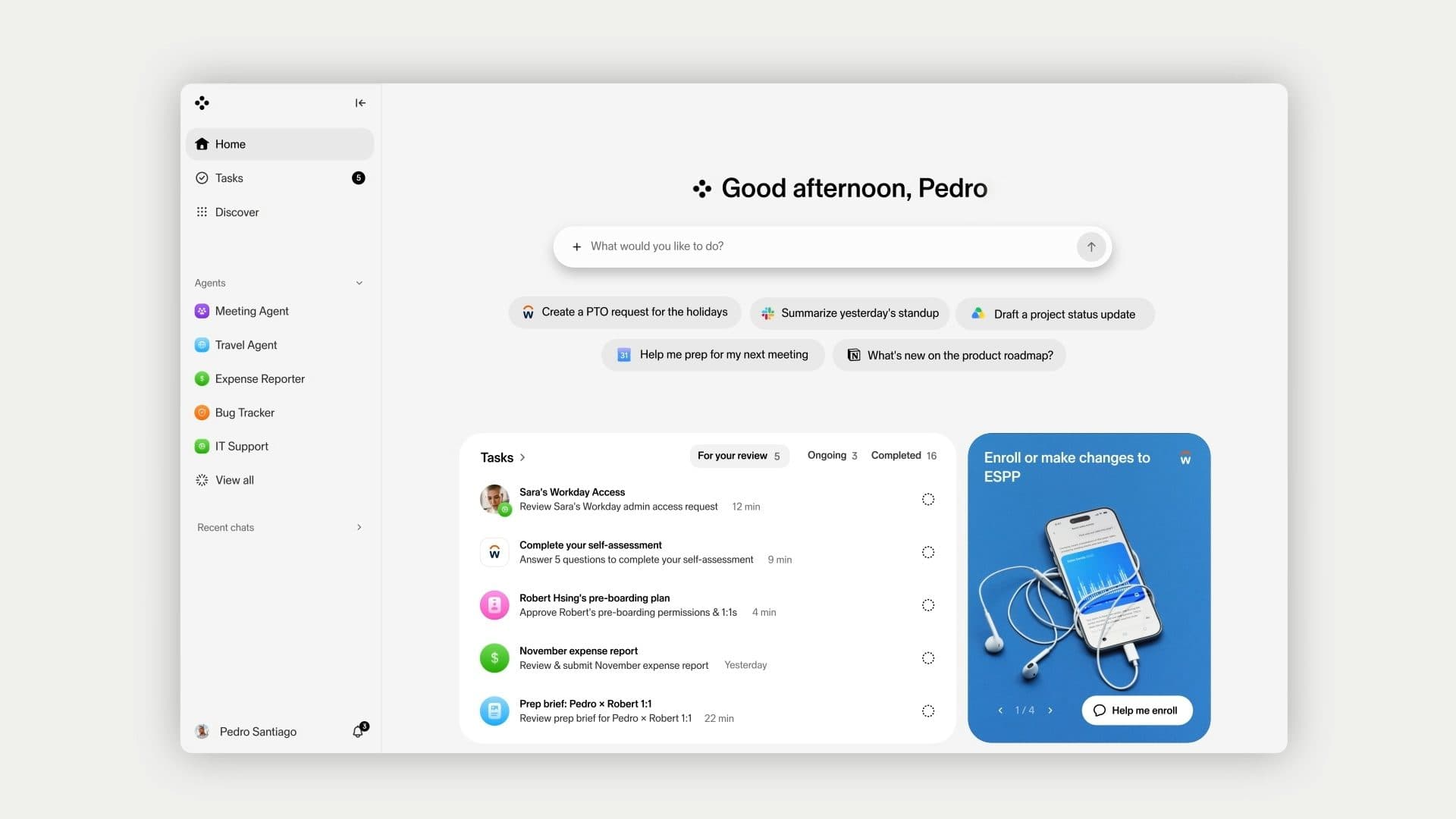
Sana, Workday's agentic experience, is now the Workday Home: one personalised view of tasks, decisions, meetings and agent activity, where employees ask in plain language and Sana runs the right agents. Sana Concierge, a new HR and IT service agent, aims to resolve requests such as onboarding, leave, payroll questions and password resets before they become tickets, handing a specialist the full case history when a person is needed.
Availability: the new Home is available now, and administrators choose when to switch it on; Sana Concierge is with early adopters, expected generally available in Q1 2027. (Workday via PR Newswire)
3. Sana inside Claude, Gemini Enterprise, Copilot, Teams and Slack
Employees will be able to request HR and finance work from the AI tools they already use. Third-party tools never get raw access to Workday data: requests go through Sana, which applies the company's permissions, policies and approvals and records every action. One connection brings Workday, customer and partner agents into all connected tools.
Availability: self-service is generally available today in Gemini Enterprise, Microsoft Copilot, Microsoft Teams and Slack, with Sana on those platforms in late 2026; Sana in Claude Cowork is in early access; Sana in Copilot Cowork is expected in early access in late 2026. (Workday)
4. A headless Trusted Agent Platform
Customers can now build and run their own agents on Workday data without going through the Workday interface. Agent-Ready Tools are Workday's Model Context Protocol (MCP) tools; Live Data Query in Workday Data Cloud lets teams and agents query live Workday data in SQL; Developer Agent turns plain-language requests into custom agents from tools such as Claude Code, Codex and Cursor; Custom Agents can use models from Anthropic, Google, Meta, Mistral, OpenAI and NVIDIA. Every agent runs on the new Agent Harness, which supplies the person's role, permissions and applicable policies and governs each action. "Headless can't mean lawless," said Gabe Monroy, Workday's chief technology officer.
Availability: Agent Harness, Agent-Ready Tools, Custom Agents, Developer Agent and Workday Data Cloud are generally available; Agent Context Service (late 2026) and Grounded Reasoning (early 2027) come in early access. (Workday)
5. Decision Intelligence for HR and finance
Decision Intelligence, first offered to planning teams in Adaptive from Workday, now covers HR and finance. HR teams can ask about workforce supply and demand, attrition risk, recruiting plans and skills gaps, compare hiring externally with building internal talent or using contingent labour, and see the cost, timing and risk of each option before acting in Workday.
Availability: now available to Workday HCM and Financial Management customers. (Workday; our flash)
6. Work Intelligence: jobs broken into tasks
Work Intelligence breaks each job into the tasks people do, links tasks to skills and shows where AI can help, what it should augment and what has to stay human. It draws on Workday Skills Cloud, which Workday says is used by more than 3,450 customers and built on more than 75,000 canonical skills. Workday says neither Work Intelligence nor Decision Intelligence makes decisions about people.
Availability: early access for Workday HCM customers. (Workday via PR Newswire)
7. Workday Candidate Profile
Job seekers will be able to save their information once and reuse it on any Workday-powered career site, signing in with an email and one-time code. Workday expects about 80% of standard fields to be pre-filled and applying to be about 40% faster. It does not rank or screen candidates.
Availability: expected generally available to Workday Recruiting customers in early 2027. (Full story)
8. A partnership with Anthropic
Workday and Anthropic announced a partnership that links Sana and Claude through MCP: work can start in either, and Workday's permissions and audit controls apply to every request. Anthropic runs its own finance and people operations on Workday Financials and Workday HCM, and Workday uses Claude Enterprise and Claude Code internally.
Availability: the Sana in Claude plugin is in early access, expected generally available in late 2026. (Workday via PR Newswire)
What HR buyers should take away
- Separate "available now" from roadmap. Decision Intelligence, the new Sana Home, Agent-Ready Tools and the agent-building tools are shipping; most autopilot agents, Sana Concierge and Candidate Profile land in late 2026 or 2027.
- Governance is the pitch. Every announcement leans on Workday's permissions, approvals and audit trails. Buyers should ask to see the action logs, the controls for what an agent may do on its own and how a human override works.
- Work is leaving the Workday screen. With Sana in Copilot, Teams, Slack and Claude, and a headless platform, HR service and data access move into the tools employees already use. That raises integration and policy questions for IT and HR together.
- Usage costs. Workday notes customers can set how often agents run to manage activity and cost — a sign that agent consumption will be a budgeting line to understand before scaling.
Image: Still from Workday's official release video, courtesy of Workday via PR Newswire. Sources: Workday Newsroom and Workday via PR Newswire, October 13, 2026, as linked above.
Verified vendor profiles for the companies named above — DHRMap wires every story to its directory.

Workday provides an enterprise AI platform for managing people, money, and AI agents across human resources, finance, spend, and planning.
Paradox makes conversational recruiting AI (assistant 'Olivia') that automates candidate screening, interview scheduling and onboarding.
Austin-based health benefits platform offering affordable, tech-driven health insurance plans to small and midsize businesses.
AI-powered talent-orchestration platform for recruiting, internal mobility and talent intelligence; acquired by Workday.
DHRMap tracks every HR-tech company over time — here's the rest of the coverage.
Workday says more than 11,500 organizations, including more than 65% of the Fortune 500, use it, so its Rising roadmap sets expectations across the enterprise HR market. The 2026 message is that agents should act, not just answer — inside the customer's existing rules. For HR leaders that shifts evaluation from features to controls: what an agent may do unattended, how actions are logged and reversed, how agent usage is priced, and which capabilities are actually generally available versus early access.