
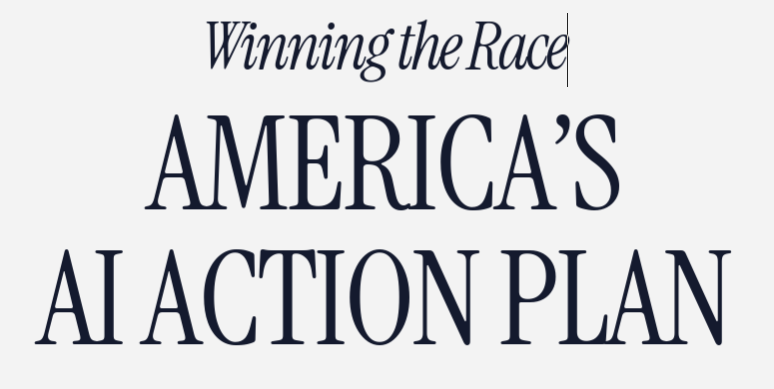
Washington, D.C., July 23, 2025 — The White House has released a sweeping 28-page blueprint titled America’s AI Action Plan, outlining over 90 federal policy directives aimed at securing U.S. dominance in artificial intelligence across innovation, infrastructure, and international diplomacy. Framed as a national imperative, the plan presents a vision of “unquestioned and unchallenged” technological leadership, spearheaded by the Trump administration and codified under Executive Order 14179, Removing Barriers to American Leadership in Artificial Intelligence.
A Tripartite Strategy
The Action Plan is anchored on three pillars:
Accelerate AI Innovation
Build American AI Infrastructure
Lead in International AI Diplomacy and Security
Each pillar is accompanied by concrete policy steps aimed at transforming the federal government's approach to AI, redefining the public-private innovation partnership, and reshaping America's global AI posture.
Pillar I: Accelerate Innovation by Removing Barriers
The plan dismantles several Biden-era regulations, notably Executive Order 14110, positioning deregulation as a catalyst for AI adoption. The document emphasizes free speech protections within AI systems and urges federal agencies to only procure AI tools that are “free from top-down ideological bias.” It also endorses the use of open-source and open-weight AI models as strategic assets for innovation, academic research, and national resilience.
On workforce strategy, the plan advocates a “worker-first AI agenda,” introducing tax incentives for private employers investing in AI upskilling and calling for a national AI Workforce Research Hub under the Department of Labor. AI adoption is further encouraged through regulatory sandboxes and public-private Centers of Excellence in healthcare, energy, and agriculture.
Pillar II: Building the Infrastructure to Power AI
Positioning AI as the next great industrial driver, the plan proposes aggressive federal action to streamline environmental permitting for data centers, semiconductor fabs, and energy infrastructure. It calls for expanded use of categorical exclusions under NEPA and prioritizes access to federal lands for large-scale tech infrastructure.
Additionally, the strategy calls for restoring American semiconductor self-sufficiency and deploying “high-security AI data centers” for military and intelligence purposes. A parallel national grid modernization plan aims to ensure the country’s energy capacity can sustain the immense computational demands of frontier models.
Workforce development also takes center stage here: the federal government will work with industry and community colleges to train electricians, HVAC technicians, and other skilled trades essential to the AI infrastructure boom.
Pillar III: International Diplomacy and Techno-Geopolitics
The plan’s international agenda emphasizes the export of a full-stack U.S. AI ecosystem—including models, hardware, and standards—to allies, aiming to counter Chinese influence in global governance bodies such as the ITU and OECD. U.S. agencies are instructed to coordinate technology diplomacy and align protection measures globally to prevent adversaries from accessing frontier compute and AI models.
In parallel, the U.S. will bolster export control enforcement and close loopholes in the semiconductor supply chain. Domestically, new efforts will evaluate the national security implications of advanced AI systems, particularly with regard to synthetic biology, cyberattacks, and deepfake media manipulation.
From Rhetoric to Execution
The Action Plan is signed by top administration officials including Assistant to the President for Science and Technology Michael Kratsios, National Security Advisor Marco Rubio, and Special Advisor David Sacks. Each policy recommendation is paired with a designated federal lead agency, ensuring execution pathways are clearly defined.
While supporters see the plan as a bold pivot toward AI-powered economic leadership, critics have raised concerns about the rollback of environmental safeguards, the weakening of AI safety mandates, and the emphasis on ideological neutrality in federal procurement—arguing it could be politically charged in implementation.
Nevertheless, the Action Plan represents a significant recalibration of federal AI priorities, moving from a precautionary governance approach to one focused on scale, speed, and strategic advantage.
“AI is our generation’s moonshot,” said one administration official. “This plan is how we get there—before anyone else does.”

Subscribe to our newsletter and never miss our latest digital HR news!
By signing up to receive DHRmap newsletter, you agree to our Terms of Use and Privacy Policy. You can unsubscribe anytime.












We have placed cookies on your device to help make this website better. You can adjust your cookie settings, otherwise we'll assume you're okay to continue.

 Back
Back

 X.com
X.com