Lockheed Martin Advances Workforce Transformation with SAP SuccessFactors Solutions
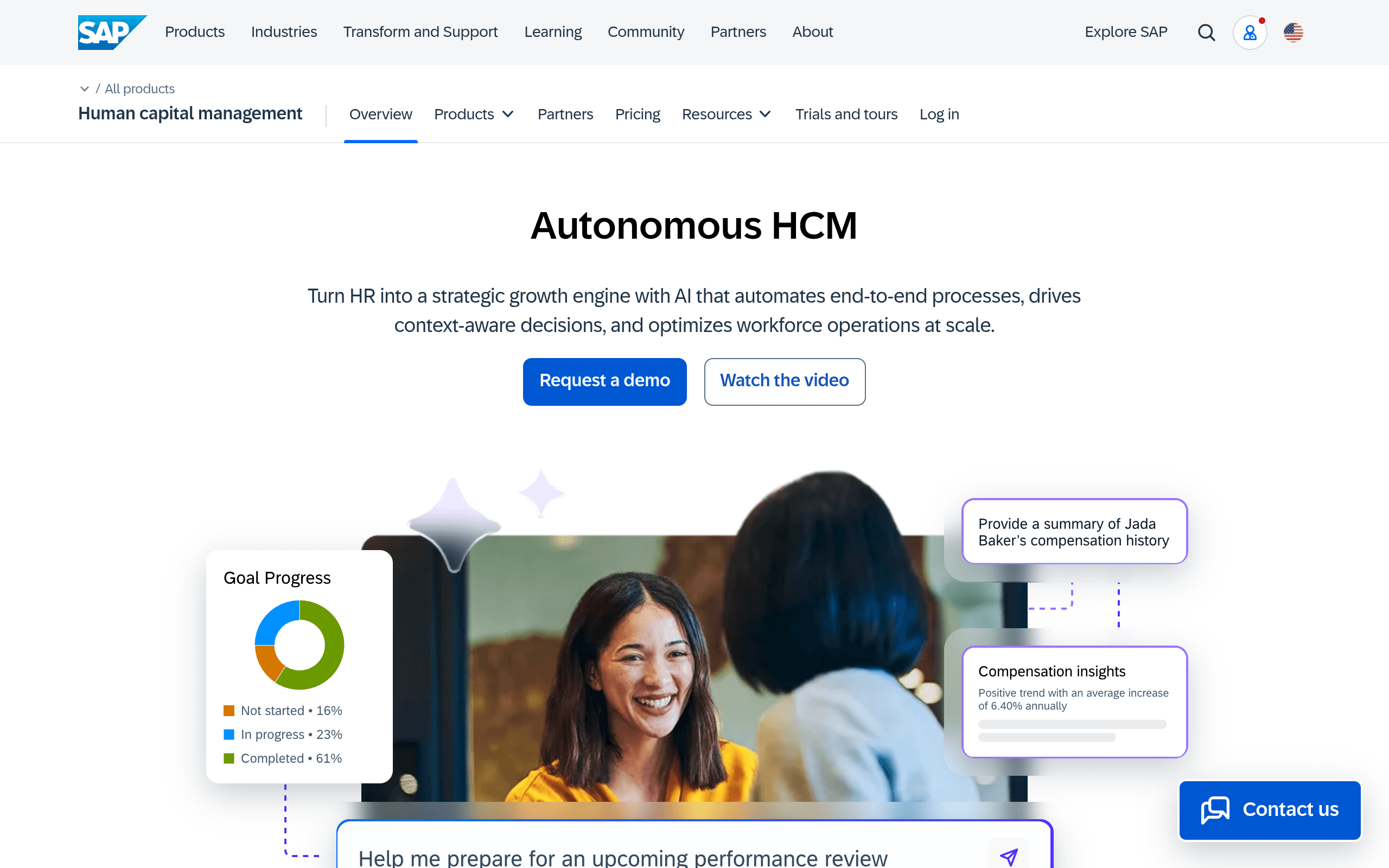
Lockheed Martin has gone live on a comprehensive SAP SuccessFactors cloud HCM suite — spanning Employee Central, Payroll, Recruiting, and Onboarding — consolidating HR operations for its approximately 123,000 employees and decommissioning legacy systems, with the unified data layer cited as a foundation for the company's broader AI workforce strategy.
Key facts
- Lockheed Martin has gone live on SAP SuccessFactors (source-claimed, September 2026)
- Modules deployed include Employee Central, Payroll, Recruiting, and Onboarding
- Approximately 123,000 employees are now on the unified platform
- Legacy HR systems are being retired as part of the transition
- A single source of workforce data is the stated architectural goal
- The unified platform is positioned as the foundation for Lockheed Martin's AI workforce strategy
- Announcement was published on SAP's own news channel — no independent verification cited
Lockheed Martin, one of the world's largest defense and aerospace contractors, has reached a major milestone in its HR transformation journey by going live with a broad suite of SAP SuccessFactors modules. According to SAP's news channel, the deployment encompasses Employee Central, Payroll, Recruiting, and Onboarding — effectively unifying the full employee lifecycle onto a single cloud platform for a workforce of approximately 123,000 people.
The move marks a deliberate shift away from fragmented legacy HR systems, which Lockheed Martin is retiring as part of this transition. By consolidating onto SAP SuccessFactors, the company aims to establish a single, authoritative source of workforce data — a prerequisite, the company indicates, for accelerating its artificial intelligence strategy across HR functions.
The deployment is notable for both its scale and its scope. Large-scale cloud HCM go-lives covering payroll in particular carry significant operational risk, making a simultaneous multi-module launch at 123,000-person scale a logistically ambitious undertaking. The inclusion of Payroll alongside talent and core HR modules suggests Lockheed Martin sought a tightly integrated platform rather than a best-of-breed patchwork approach.
Strategically, the framing around AI is significant. By centralizing workforce data in Employee Central, Lockheed Martin positions itself to layer AI-powered capabilities — such as predictive talent analytics, intelligent recruiting, and workforce planning — onto a clean, unified data foundation. The defense sector has historically been cautious with HR technology modernization due to regulatory complexity and security requirements, making this go-live a potential bellwether for peer organizations.
Note: This announcement originates from SAP's own media channel and should be treated as vendor-attributed. Independent verification of go-live scope, timeline, and AI capability specifics is advisable before drawing broader conclusions.
Verified vendor profiles for the companies named above — DHRMap wires every story to its directory.

DHRMap tracks every HR-tech company over time — here's the rest of the coverage.
When a 123,000-person defense contractor consolidates its entire HR stack — including payroll — onto a single cloud platform and explicitly links that move to an AI strategy, it signals a maturation of enterprise HCM thinking. It demonstrates that even highly regulated, operationally complex organizations are prioritizing data unification as the prerequisite for AI-era workforce management, a thesis central to DHRMap's editorial perspective.
Work at SuccessFactors? Claim the profile — free · Get featured on DHRmap — from $1,000/year
Have HR-tech news? Submit it free · Publish a Sponsored article — $300