Mercor Raises $750M Series D at a $20B Valuation to Bring AI Evals and Post-Training to Enterprises
Mercor, which says more than five million experts are paid through its network to train frontier AI models, will put the money into evals, post-training and environments where AI agents learn enterprise workflows.
Key facts
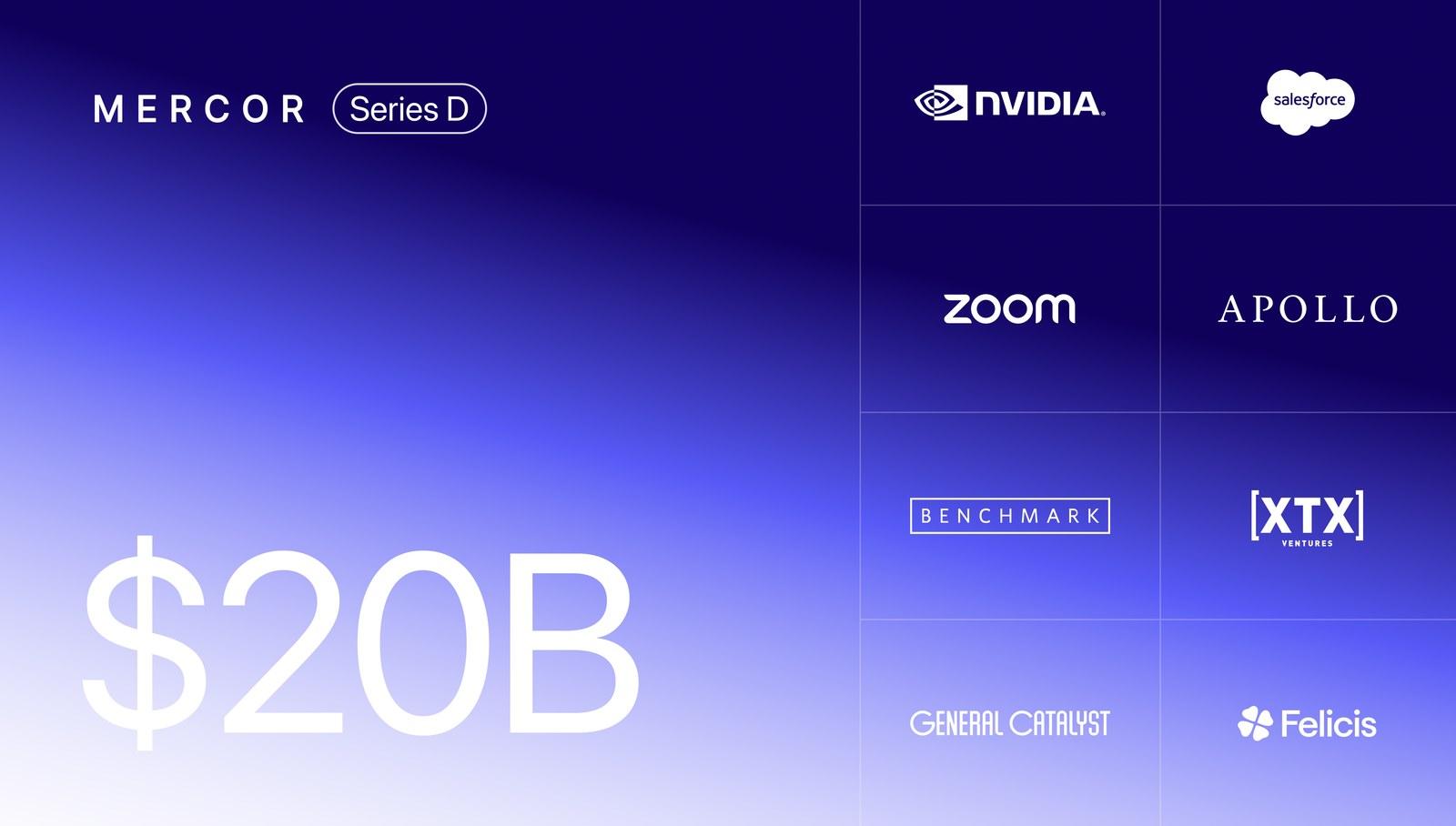
- Mercor announced a $750 million Series D valuing the company at $20 billion (Mercor blog, November 10, 2026, by co-founder and CEO Brendan Foody).
- The round included an employee tender. Investors named: Benchmark, Felicis, Fundomo, funds managed by affiliates of Apollo, G Squared, General Catalyst, Glade Brook Capital, NVIDIA, Salesforce, Sapphire Ventures, StepStone Group, XTX Ventures and Zoom. The post names no lead investor.
- Mercor says more than five million experts in its network are paid to train frontier AI models based on their knowledge.
- The funding goes to infrastructure and research for evals and post-training, and to building more environments where AI agents can learn complex workflows.
- Mercor says its frontier-lab capabilities are now being adopted by big tech, open-model developers, application-layer companies and the Fortune 500.
- Mercor opened offices in New York and London this year, beyond San Francisco.
Mercor has announced a $750 million Series D that values the company at $20 billion, co-founder and CEO Brendan Foody wrote in a post on the company's blog on November 10, 2026. The round included an employee tender, with participation from investors including Benchmark, Felicis, Fundomo, funds managed by affiliates of Apollo, G Squared, General Catalyst, Glade Brook Capital, NVIDIA, Salesforce, Sapphire Ventures, StepStone Group, XTX Ventures and Zoom. The post does not name a lead investor.
From frontier labs to enterprises
Mercor says it spent the last two years building infrastructure to train and evaluate frontier AI models on real-world work with human expertise, and is now bringing the same capabilities to enterprises: evaluating what AI agents can do, what they cost and how to improve their performance. According to the company, those capabilities are being adopted by big tech, developers of open models, application-layer companies and the Fortune 500.
"Every job in the economy will need its own agents that can perform tasks reliably and efficiently," Foody wrote.
Mercor works with enterprises and domain experts to build custom evals based on a company's actual workflows. Foody argues that professional work depends on two kinds of knowledge a model does not have by default: how a task gets done, and how a specific company does it according to its systems, policies or quality bar. He notes that the United States alone has more than 800 distinct occupations, each with workflows models have yet to be evaluated against.
That is the reason Mercor gives for its acquisition of Deeptune earlier this year: Deeptune's team spent two years recreating hundreds of enterprise applications where AI agents can practice professional workflows.
Five million experts
Mercor says it has "created a new category of work," with more than five million experts in its network getting paid to train frontier AI models based on their knowledge.
What the money is for
Mercor says the funding accelerates its investment in infrastructure and research for evals and post-training, and in building more environments where agents can learn complex workflows. The company has also grown beyond San Francisco this year, opening offices in New York and London.
Foody wrote that Mercor already spends three times as much on inference as on employee salaries. In his view, if that ratio holds as AI spreads through the economy, it points to something closer to double-digit GDP growth over the next five years.
DHRMap previously covered Mercor's $350 million Series C at a $10 billion valuation in October 2025.
Image: Mercor. Source: [Mercor](https://www.mercor.com/blog/series-d/).
Verified vendor profiles for the companies named above — DHRMap wires every story to its directory.

DHRMap tracks every HR-tech company over time — here's the rest of the coverage.
Mercor began as an AI hiring platform and now pays a network it puts at more than five million domain experts to train and evaluate AI models — a new kind of contingent, expert-by-the-task work at large scale. Its pitch to enterprises is that agents fail in production without two kinds of knowledge: how a job's tasks get done, and how this company does them. That puts workflow and role knowledge, which HR and workforce-planning teams hold, at the centre of agent deployment, and a $20 billion valuation shows how much investors are betting on it.
Work at Mercor? Claim the profile — free · Get featured on DHRmap — from $1,000/year
Have HR-tech news? Submit it free · Publish a Sponsored article — $300